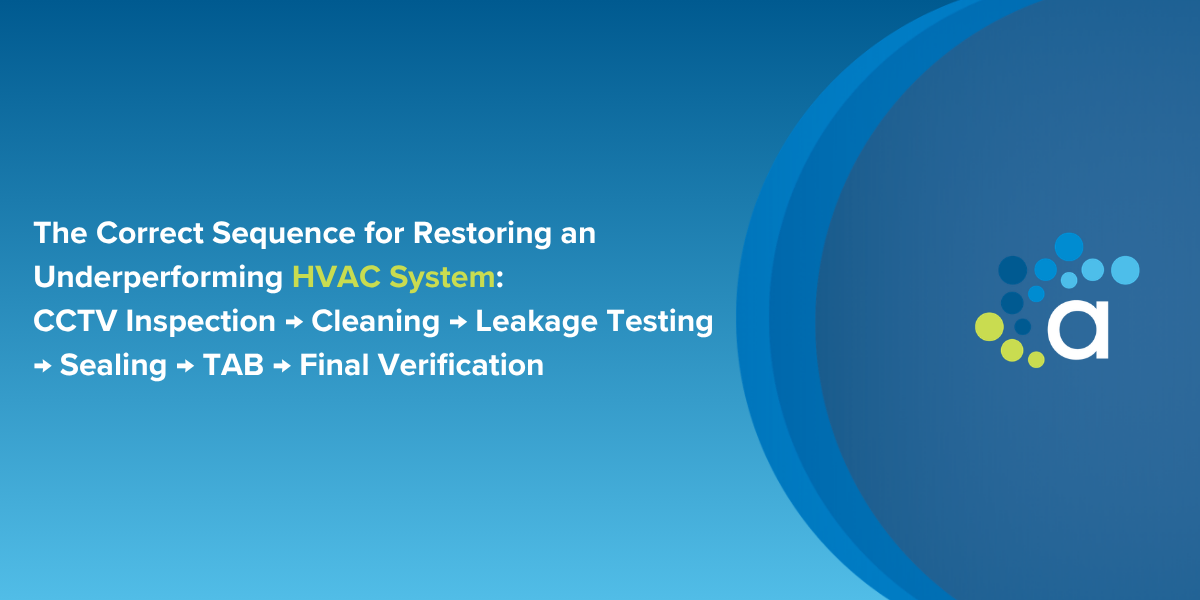
The Correct Sequence for Restoring an Underperforming HVAC System: CCTV Inspection → Cleaning → Leakage Testing → Sealing → TAB → Final Verification

An underperforming HVAC system in a Saudi commercial building can produce any combination of the following symptoms: some zones consistently too warm, others too cool; energy consumption significantly above design benchmarks; HVAC equipment running continuously at full capacity without achieving setpoints; occupant complaints about air quality, stuffiness, or uneven comfort; and maintenance teams unable to balance the system regardless of damper and fan adjustments.
Each of these symptoms has multiple possible causes, and identifying and addressing the correct cause — in the correct order — is the difference between a restored, performing system and one that has been repeatedly adjusted without underlying improvement. The sequence in which HVAC remediation activities are performed is not arbitrary. Performing activities in the wrong order produces inaccurate results, creates repeated work, and leaves root causes unaddressed. This article describes the correct sequence for restoring an underperforming HVAC system in Saudi Arabia, explains why the sequence matters, and identifies what each stage contributes to the overall outcome.
Stage 1: CCTV Robotic Inspection
Before any cleaning, testing, or sealing work begins, the internal condition of the duct system must be established by visual inspection. CCTV robotic inspection — using remote-controlled camera systems capable of navigating supply and return ductwork of all dimensions — provides a complete internal condition record: contamination levels and distribution, structural damage and collapsed sections, presence of foreign objects, condition of internal linings, locations of access hatches and dampers, and evidence of existing leakage or moisture ingress.
This inspection serves three critical purposes. First, it confirms whether the duct system is structurally sound enough to be cleaned, tested, and sealed — a severely damaged or obstructed system may require physical repairs before other activities. Second, it provides the baseline contamination record against which post-cleaning condition can be compared and verified. Third, it identifies specific problem locations — collapsed flexible duct sections, dislodged dampers, blocked terminal boxes — that can be addressed as specific work items rather than discovered during cleaning.
Performing cleaning before inspection means cleaning blind — without knowing what is being cleaned, where the worst contamination is, or whether structural damage requires addressing before cleaning equipment can safely traverse the duct run.
Stage 2: NADCA-Standard Duct Cleaning
With the duct system’s condition documented, cleaning is performed to NADCA ACR standard. The process includes mechanical agitation of duct internal surfaces using contact cleaning tools, HEPA-filtered negative air machine extraction to capture all dislodged contamination, cleaning of air handling unit components including coils, drain pans, fans, and filter housings, and post-cleaning inspection to verify the target cleanliness standard has been achieved.
Cleaning must precede leakage testing because contamination accumulation — particularly at seams, joints, and access panels — can partially obscure leakage pathways and produce a leakage test result that underestimates the true leakage of the clean duct system. More practically, applying Aeroseal duct sealing to a contaminated system is counterproductive: the sealant bonds to contamination particles rather than the duct substrate, producing a poor-quality seal that degrades quickly.
Stage 3: Duct Pressure Leakage Testing
After the duct system is clean, a pressurisation test establishes the total leakage rate. All supply and return terminals are sealed, a calibrated duct blaster is connected at the AHU, the system is pressurised to the standard test pressure, and the airflow required to maintain pressure is measured. The result — expressed as a percentage of design supply airflow — determines whether the system meets the Saudi Building Code threshold (4% for commercial systems) or requires sealing.
Testing after cleaning and before sealing provides the pre-sealing baseline that gives the post-sealing test result its meaning. Without a pre-sealing test, the post-sealing certificate has no comparison point — there is no documented evidence of how much improvement the sealing achieved.
Testing before TAB is essential because duct leakage directly invalidates TAB results. A TAB measurement taken on a leaky duct system records airflows as the system is compensating for leakage, not as it is designed to operate. The measured flows are unreliable, the balance adjustments made against them are incorrect, and the commissioning report is built on a false foundation.
Stage 4: Aeroseal Internal Duct Sealing
Where the leakage test reveals leakage above the acceptable threshold — as it does in the majority of Saudi commercial buildings assessed — Aeroseal’s internal sealing process brings the system into compliance. The system pressurises the duct network and introduces sealant aerosol from the AHU connection point. The sealant migrates through the pressurised system to every leakage pathway — including those in inaccessible concealed runs — and seals them from the inside. The process is monitored continuously until the target leakage level is confirmed, at which point a performance certificate is generated.
Sealing after testing provides documented before-and-after evidence of the improvement. Sealing before testing — which sometimes occurs when sealing is treated as a remediation measure without a preceding test — produces a sealed system whose pre-sealing condition is unknown and whose compliance cannot be verified.
Stage 5: Testing, Adjusting and Balancing (TAB)
With the duct system clean, tested, and verified at the target leakage level, TAB can proceed on a solid foundation. The airflows measured at terminal units now reflect the system’s actual delivery capability without the distortion of variable leakage. Damper adjustments, fan speed settings, and control sequences can be set to deliver design airflows to all zones. The resulting TAB report is a reliable document — it describes a system performing as designed, not compensating for infrastructure deficiencies.
Stage 6: Final Verification
The final verification stage confirms that the complete remediation programme has achieved its objectives. It includes a repeat airtightness or duct leakage test to confirm the post-sealing performance has been maintained, a commissioning review comparing measured airflows against design targets, energy monitoring to establish post-remediation consumption as a benchmark, and documentation assembly — inspection records, cleaning report, pre- and post-sealing test certificates, TAB report, and final commissioning summary.
This complete documentation package is the deliverable that matters most to the building owner. It demonstrates that the HVAC system has been systematically assessed, cleaned, sealed, balanced, and verified — and provides the performance baseline for future maintenance planning.
Conclusion
HVAC remediation activities performed out of sequence produce incomplete results at best and contradictory results at worst. The correct sequence — inspection, then cleaning, then leakage testing, then sealing, then TAB, then final verification — ensures that each activity contributes maximum value and that the final outcome is a genuinely restored, documented, and verifiable HVAC system. Aeroseal Arabia provides all stages of this integrated remediation sequence for Saudi commercial and institutional buildings. Contact our team to discuss a full HVAC performance restoration programme for your building.