

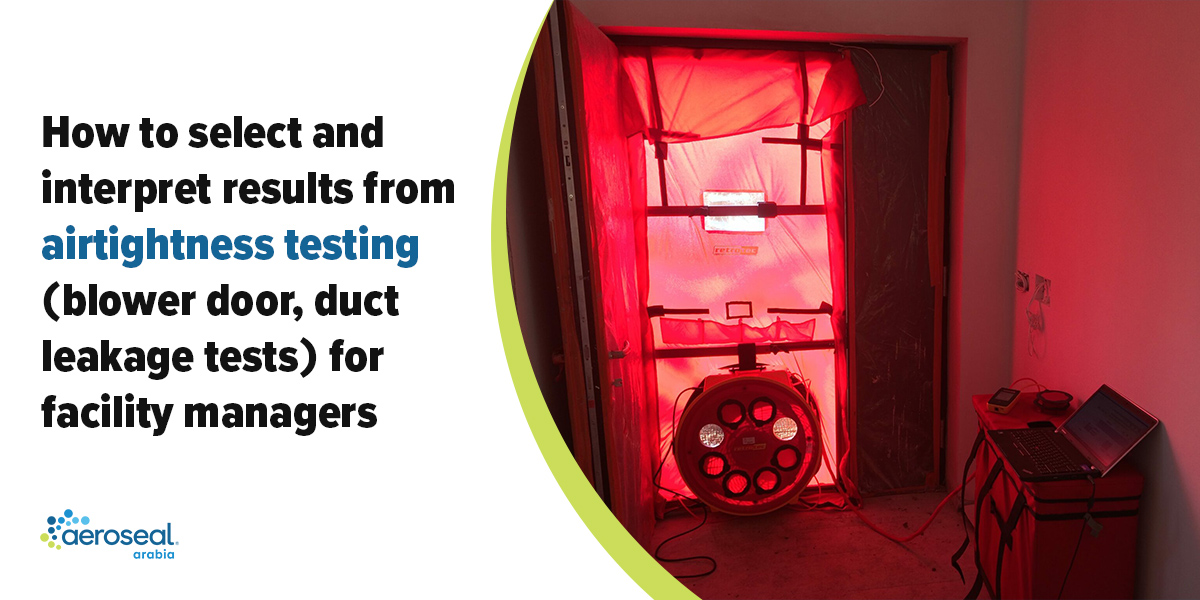
How to Select and Interpret Results from Airtightness Testing for Facility Managers

For facility managers in Saudi Arabia, airtightness testing is no longer a niche technical exercise. It is a critical tool for controlling energy costs, improving HVAC performance, and meeting building code and sustainability requirements. Tests such as blower door testing and duct leakage testing provide measurable data, but their value depends on selecting the right test and correctly interpreting the results.
This guide explains how facility managers can choose the appropriate airtightness tests and understand what the results actually mean for building performance, operating costs, and corrective actions.
Why Airtightness Testing Matters for Facility Management
In hot climates like Saudi Arabia, uncontrolled air leakage significantly increases cooling loads. Even well-designed HVAC systems struggle to perform when conditioned air escapes or hot outdoor air infiltrates the building.
Airtightness testing helps facility managers:
Identify hidden energy losses
Verify building and HVAC performance
Reduce cooling demand and electricity bills
Support compliance with SBC and sustainability programs
Improve indoor air quality and occupant comfort
Without testing, most decisions are based on assumptions rather than measured performance.
Understanding the Two Key Airtightness Tests
Facility managers typically rely on two main tests, each serving a different purpose.
Blower Door Testing Explained
A blower door test measures how airtight the building envelope is. A powerful fan is temporarily installed in an exterior door to pressurize or depressurize the building. Sensors then measure how much air leaks through walls, roofs, windows, doors, and other envelope components.
What this test tells you:
Overall envelope air leakage
How much uncontrolled outdoor air enters the building
Whether the building meets airtightness targets or code requirements
Blower door testing is especially important for:
Commercial buildings
Healthcare and education facilities
High-efficiency or green-certified projects
New construction and major retrofits
Duct Leakage Testing Explained
Duct leakage testing focuses specifically on HVAC ductwork. It measures how much conditioned air is lost through leaks in supply and return ducts before it reaches occupied spaces.
What this test tells you:
Percentage of air lost through duct leaks
Impact on airflow delivery and system balance
Reasons for high HVAC energy consumption
This test is critical in Saudi buildings, where duct leakage can reach 20 to 40 percent if not properly sealed.
How to Select the Right Test
Facility managers should select tests based on the problem they are trying to solve.
If energy bills are high and cooling performance is poor across the building, start with a blower door test to evaluate the envelope.
If some zones are too hot or too cold, airflow is weak, or HVAC systems run continuously, duct leakage testing is essential.
In many cases, both tests are needed. A building can have a tight envelope but leaky ducts, or sealed ducts inside a highly leaky structure. Only testing provides clarity.
Key Metrics Facility Managers Must Understand
Test reports include technical numbers that are often misunderstood. Knowing what they mean helps you make informed decisions.
Air Changes per Hour (ACH)
ACH indicates how many times the building’s air volume is replaced per hour at a specific pressure, usually 50 Pascals.
Lower ACH values mean better airtightness
Higher ACH values indicate excessive leakage
For many commercial buildings, lower ACH directly translates into lower cooling demand and better pressure control.
CFM Leakage Values
CFM measures how much air is leaking, expressed in cubic feet per minute.
In blower door tests, it shows total envelope leakage
In duct leakage tests, it shows how much air escapes the duct system
Facility managers should focus on how these values compare to building size and design expectations, not just absolute numbers.
Leakage as a Percentage of Airflow
In duct testing, leakage is often shown as a percentage of total system airflow.
Below 5 percent indicates high-performing duct systems
10 percent or higher signals major energy waste
High percentages usually justify immediate duct sealing.
How to Interpret Results Correctly
Airtightness results should always be interpreted in context.
A building that technically meets code limits may still perform poorly if HVAC systems are oversized or pressure is poorly balanced.
Compare test results with:
Energy consumption data
Cooling complaints and comfort issues
Humidity levels and indoor air quality reports
If airtightness results improve but energy use remains high, airflow balancing or system controls may need attention.
Turning Test Results into Action
Testing without corrective action has little value. Facility managers should use results to define clear next steps.
High envelope leakage calls for targeted envelope sealing, especially around roofs, façades, service penetrations, and window interfaces.
High duct leakage requires duct sealing solutions. Advanced internal sealing technologies can address leaks without opening ceilings or disrupting operations.
After sealing, re-testing is essential to confirm improvement and document performance gains.
The Importance of Post-Sealing Verification
Facility managers should always require before-and-after testing.
Verification confirms:
Actual reduction in air leakage
Improvement in HVAC efficiency
Justification for energy savings claims
Support for audits, certifications, and compliance
This data is also valuable for long-term asset management and budgeting.
Common Mistakes Facility Managers Should Avoid
Relying on visual inspections instead of testing
Assuming new buildings are automatically airtight
Ignoring duct leakage because it is hidden
Failing to re-test after repairs or sealing
Treating test reports as paperwork instead of performance tools
Avoiding these mistakes protects both operational budgets and building longevity.
Conclusion
For facility managers, airtightness testing is one of the most powerful tools for understanding and improving building performance. Selecting the right test and correctly interpreting the results allows you to reduce cooling costs, improve comfort, extend HVAC lifespan, and meet regulatory and sustainability goals.
Blower door testing reveals how the building envelope performs, while duct leakage testing shows how efficiently HVAC systems deliver conditioned air. Together, they provide a complete picture of where energy is lost and how to fix it.
In Saudi Arabia’s demanding climate, airtightness testing is not just a technical check. It is a strategic facility management decision that delivers measurable, long-term value.