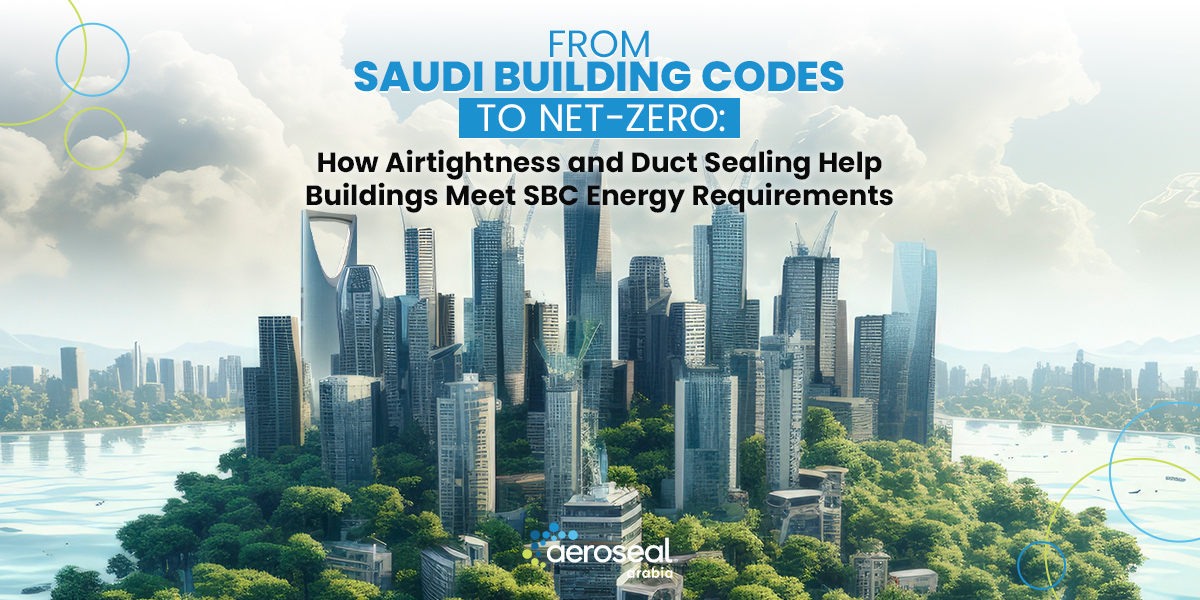
From Saudi Building Codes to Net-Zero: How Airtightness and Duct Sealing Help Buildings Meet SBC Energy Requirements

Saudi Arabia’s construction sector is undergoing a major transformation. With stricter enforcement of the Saudi Building Code (SBC) and national commitments to Vision 2030 and Net-Zero 2060, energy efficiency is no longer optional it is a regulatory and financial necessity.
At the center of this shift is one critical factor many buildings still underestimate: airtightness. Poorly sealed building envelopes and leaking HVAC ductwork are among the biggest reasons projects fail to meet SBC energy requirements, experience high cooling loads, and struggle with long-term operational costs.
This article explains how airtightness testing, envelope sealing solutions, and HVAC duct loss reduction directly support SBC compliance and set the foundation for Net-Zero buildings in Saudi Arabia.
Understanding SBC Energy Requirements and Airtightness
The Saudi Building Code (SBC 601 & SBC 602) focuses heavily on reducing energy waste caused by uncontrolled air movement. In Saudi Arabia’s extreme climate, air leakage can account for up to 30 40% of cooling energy loss, especially in large commercial and institutional buildings.
Key SBC objectives include:
- Lower HVAC energy consumption
- Reduced cooling demand
- Improved indoor air quality (IAQ)
- Verified building performance through testing
To achieve this, SBC increasingly emphasizes:
- Air tightness testing
- Building envelope commissioning
- Duct leakage testing
- Measurable performance not assumptions
Why Airtightness Is Critical in Saudi Arabia’s Climate
Saudi buildings face unique challenges:
- Extreme outdoor heat
- High cooling dependency
- Coastal humidity in cities like Jeddah and Dammam
- Long HVAC operating hours
When a building is not airtight:
- Hot outdoor air infiltrates continuously
- HVAC systems operate longer and harder
- Chilled water systems lose efficiency
- Indoor humidity rises, increasing mold risk
- Energy savings targets are missed
This is why airtight buildings are foundational to Net-Zero performance, not an optional upgrade.
The Role of Airtightness Testing in SBC Compliance
Air Tightness Testing
Air tightness testing (Blower Door testing) measures how much uncontrolled air enters or escapes a building. SBC requirements increasingly demand proof of airtight performance especially for government, healthcare, and high-efficiency projects.
Benefits include:
- Identifying envelope leakage points
- Verifying compliance before handover
- Reducing HVAC oversizing
- Supporting green building solutions
Duct Leakage Testing
HVAC duct systems can lose 20 40% of conditioned air if not properly sealed. SBC energy models assume low duct leakage meaning unsealed ducts directly cause compliance failure.
Testing supports:
- HVAC duct loss reduction
- Improved airflow solutions
- Accurate airflow balancing in Saudi Arabia
- Better FCU cleaning and system efficiency
How Duct Sealing Supports Net-Zero and SBC Targets
Duct sealing is one of the fastest ways to achieve measurable energy savings HVAC-wide.
Unsealed ducts cause:
- Pressure imbalance
- Higher fan energy use
- Reduced airflow to occupied zones
- Poor indoor air quality
When ducts are sealed:
- Cooling demand drops immediately
- HVAC energy efficiency improves
- Indoor air quality tests show better results
- Equipment lifespan increases
Advanced solutions such as Aeroseal technology seal leaks internally, even in inaccessible duct sections making them ideal for large Saudi buildings and retrofit projects.
Building Envelope Sealing: The Missing Link
Even with efficient HVAC equipment, buildings fail SBC requirements if the envelope leaks air.
Common leakage points include:
- Wall-to-roof junctions
- Utility penetrations
- Window and façade interfaces
- Shaft and service risers
Envelope sealing solutions combined with thermal imaging leak detection allow teams to:
- Locate hidden leakage paths
- Verify sealing effectiveness
- Support building envelope commissioning
- Prevent future energy losses
This process is essential for Net-Zero readiness.
Airtightness, IAQ, and Long-Term Performance
SBC compliance isn’t just about energy it’s also about occupant health and building durability.
Airtight buildings support:
- Better IAQ solutions
- Controlled ventilation strategies
- Reduced dust and pollutants
- Lower humidity-related mold risks
When combined with:
- Robotic duct cleaning
- Dry ice blasting for duct hygiene
- FCU cleaning
- Indoor air quality testing
Buildings achieve both energy efficiency and healthy indoor environments, which is critical for hospitals, schools, and commercial developments.
Why Net-Zero Buildings Fail Without Airtightness
Many Saudi Net-Zero projects underperform because:
- Airtightness is addressed too late
- Duct sealing is overlooked
- No post-installation testing is conducted
- Energy models assume ideal conditions
Without verified airtight performance:
- Cooling loads exceed design limits
- Renewable systems underperform
- Operating costs rise
- Compliance risks increase
Airtightness is the foundation not the finishing touch.
Conclusion: Airtightness Is the Bridge Between SBC and Net-Zero
From Saudi Building Code compliance to Net-Zero ambitions, airtightness and duct sealing are no longer optional technical details. They are core performance requirements that directly impact:
- HVAC energy efficiency
- Cooling load reduction
- Indoor air quality
- Long-term operational savings
- Regulatory compliance
By integrating air tightness testing, duct sealing, envelope sealing solutions, and commissioning, Saudi buildings can move confidently from SBC compliance today to Net-Zero performance tomorrow.
For developers, consultants, and facility managers, airtightness is no longer a hidden issue it is a measurable, solvable, and essential part of modern building performance in the Kingdom.